
The most common call C.O.R.S gets after a homeowner has received two or three staircase quotes: “Why is there such a huge difference between quotes?” The second most common: “My quote came in at $18,000. What’s driving that number?” This post explains the seven factors that have the most impact on staircase cost in Ontario — in order of their typical effect on project price.
Ontario homeowners can verify licensed staircase contractors at the Home Construction Regulatory Authority (HCRA) — C.O.R.S Designs is a fully registered Ontario staircase contractor.
Factor 1: Structural System (Biggest Impact — $5,000–$7,000 swing)
The choice between a wood box stringer (traditional), double-stringer (open riser), and mono-stringer (floating) is the single biggest cost driver in a custom staircase project. A 13-step traditional staircase with closed risers starts around $8,000. The same project with a mono-stringer floating design starts around $14,000. The difference is the structural steel fabrication, powder coat finishing, and P.Eng engineering review required for the mono-stringer — none of which exist in a wood stringer project.
Cost impact: +$5,000–$7,000 from traditional to floating (all else equal).
Factor 2: Railing Type (Second Biggest — $2,000–$4,000 swing)
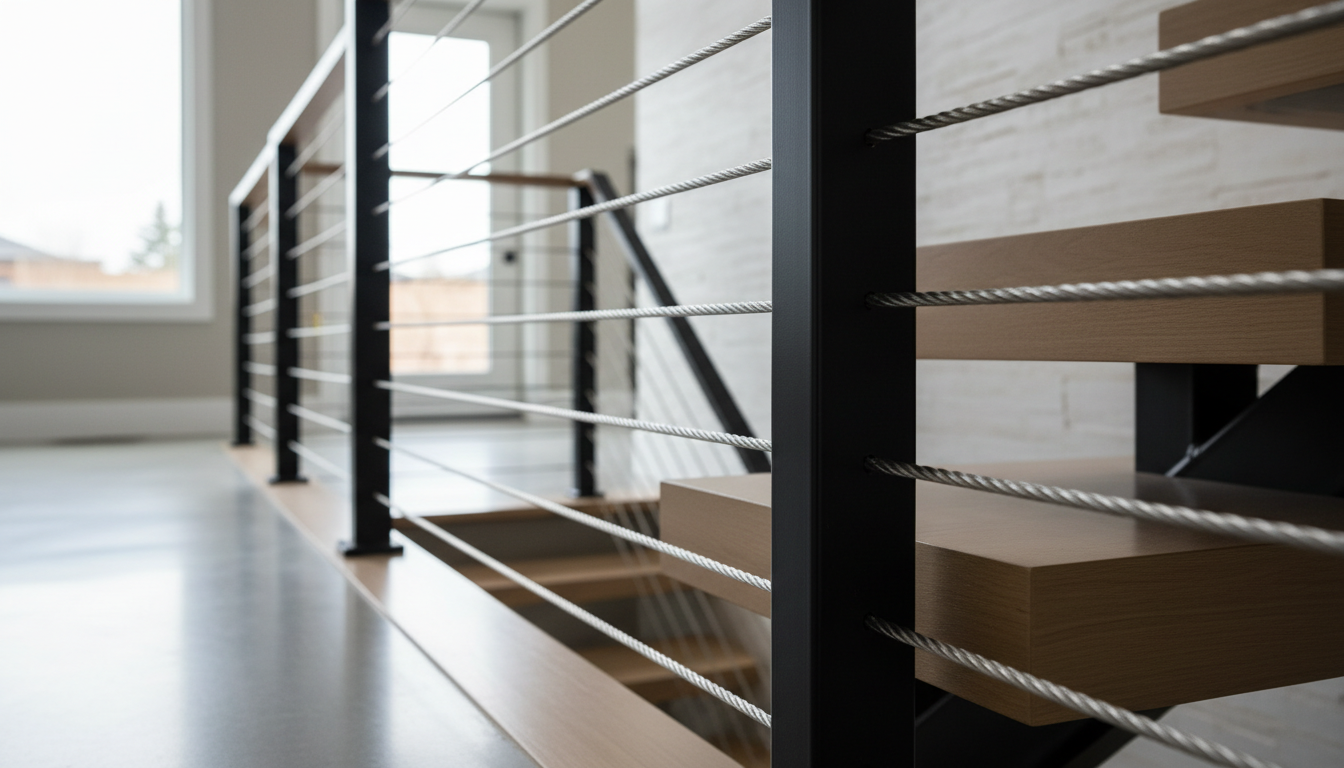
The railing system is quoted separately from the structural stringer in most fabricator quotes, but it’s a major component of total cost. Steel baluster railing runs $65–$90 per linear foot. Glass panel (post-and-channel) runs $120–$160 per linear foot. For a 4m railing run, that’s a $2,200–$2,800 difference on railing alone. On a project with both staircase railing and upper landing guardrail (7–8m total railing), the difference grows to $3,850–$4,900.
Cost impact: +$2,000–$4,000 (glass vs. baluster, typical project).
Factor 3: Tread Species (Third Most Variable — $3,000–$5,000 swing)
White oak treads are the baseline specification. Black walnut costs 60–90% more per board foot, and the material selection process is more intensive (sapwood excluded). For a 13-tread staircase, the material upgrade from white oak to walnut adds $3,000–$5,000 to the tread scope alone. This is a pure material choice — the fabrication labour is similar for both species.
Cost impact: +$3,000–$5,000 (walnut vs. white oak).
Factor 4: Floor-to-Floor Height (Structural — $1,000–$3,000 swing)
The floor-to-floor height determines the number of risers (steps) and the total stringer length. A standard 8-foot (2,440mm) ceiling height produces 13–14 risers at optimal OBC rise dimensions. A 9-foot ceiling (2,740mm) produces 15–16 risers. Each additional riser adds a tread, a bracket, and stringer length — the cost increases proportionally. A staircase for a 10-foot ceiling (more common in newer Ontario builds) is meaningfully more expensive than the same design for 8-foot ceilings.
Cost impact: +$1,000–$3,000 (10-foot vs. 8-foot ceiling, same design).
Factor 5: Configuration Complexity (Layout — $2,000–$5,000 swing)
A straight staircase (single flight, no turns) is the simplest fabrication. An L-shaped staircase (one 90° turn at a landing) requires a landing platform, a change of direction in the stringer, and additional railing at the landing perimeter. A U-shaped staircase adds another turn. Each turn adds fabrication complexity, material, and installation time.
Cost impact: +$2,000–$5,000 (L-shaped vs. straight, same structural system).
Factor 6: Engineering Requirements (Fixed — $1,500–$2,500 added cost)
A mono-stringer floating staircase requires a P.Eng stamped letter for the permit application. The letter confirms beam sizing, base plate connection, bracket specification, and deflection. C.O.R.S includes engineering in our project scope — it is not billed separately. But it is a real cost that is embedded in the mono-stringer project price and does not exist in wood stringer projects. If you’re comparing a wood stringer quote to a mono-stringer quote, this engineering cost is part of the price difference.
Cost impact: +$1,500–$2,500 (mono-stringer projects only; included in C.O.R.S scope).
Factor 7: Tread Width and Landing Size
The standard Ontario residential staircase is 36″ (914mm) clear width. Wider staircases — 42″ (1,067mm) or 48″ (1,220mm) — require longer tread stock, a wider stringer, and more railing linear footage. The cost increase for a 42″ staircase vs. a 36″ staircase is typically $1,500–$3,000. A landing platform at the base or mid-flight adds both material and installation time.
Cost impact: +$1,500–$3,000 (42″ vs. 36″ width).
Reading a Quote: What Should Be Included
A complete Ontario staircase quote should specify:
- Design drawings and shop drawings
- Permit application and all permit fees (or clearly excluded with a cost estimate)
- Engineering review if mono-stringer (or clearly excluded)
- All material — stringer, treads, risers if any, railing hardware, glass if applicable
- Fabrication and workshop dry-fit
- Delivery and installation (on-site assembly)
- Post-installation touch-up
C.O.R.S quotes include all of the above in one all-in price. When comparing quotes, confirm which items each quote includes and which are excluded — a lower quote that excludes permit fees, engineering, and delivery can easily exceed a higher all-in quote once those items are added.
→ Full Ontario staircase cost guide — all configurations with pricing
→ Floating vs. traditional staircase: the cost difference explained
→ Request a free on-site measurement and all-in written quote from C.O.R.S
Frequently Asked Questions
What is the biggest factor in staircase cost?
The structural system is the biggest single factor. A traditional wood box stringer staircase starts around $8,000. A mono-stringer floating staircase starts around $14,000. The $5,000–$7,000 difference comes from structural steel fabrication, powder coating, and P.Eng engineering — none of which exist in a wood stringer project. The railing type is the second biggest factor ($2,000–$4,000 swing, glass vs. baluster).
Why do staircase quotes vary so much between contractors?
Quotes vary because fabricators include different scope. Some exclude permit fees, engineering, and delivery — the quote looks lower, but the all-in cost is similar or higher. Also, in-house fabricators (who build their own stairs) and sub-contracting installers (who source from a third-party fabricator) have different cost structures. In-house fabricators typically offer better quality control and comparable pricing because they control the full process.
Staircase Cost Ontario: Related Resources
- Custom staircase cost Ontario — complete 2026 price guide with all staircase types and structural systems
- Floating staircase cost Ontario — mono-stringer floating staircase pricing with P.Eng inclusion
- Glass railing staircase cost Ontario — frameless vs. post glass systems and full price guide
- Staircase materials Ontario — how tread species choice affects cost: maple vs. oak vs. walnut
- Floating vs. traditional staircase Ontario — full structural and cost comparison between systems
- Staircase permit Ontario — what permit costs add to your total project budget
Get a fully itemized C.O.R.S quote in Barrie or Ontario: 705-999-0000 | corsstairs.ca/contact
One Response