
Homeowners choosing between cable railing and steel baluster railing for a custom Ontario staircase are making a decision that affects visual openness, maintenance, OBC compliance approach, and cost. This guide gives you a direct comparison so you can make the right choice for your specific project.
Cable Railing: When It Works and When It Doesn’t
The Case For Cable Railing
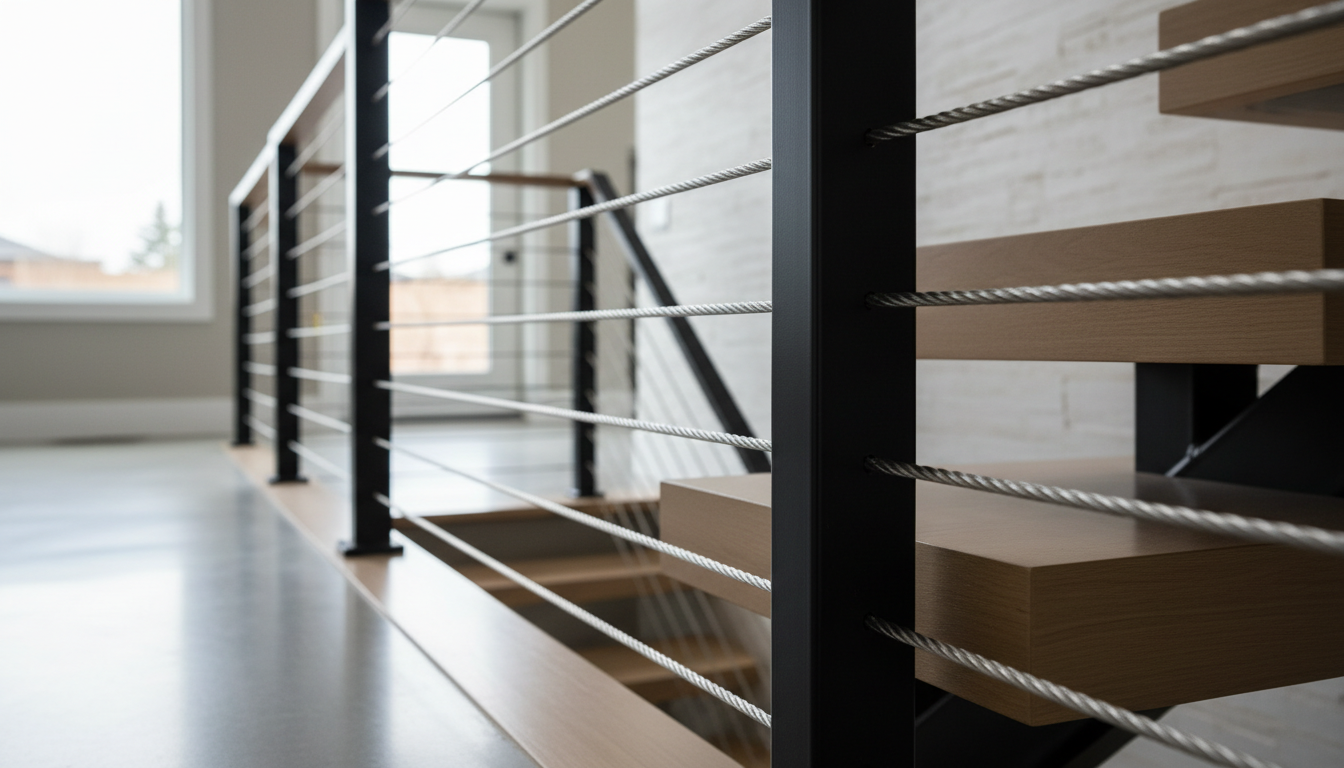
- Visual openness: Horizontal cables create a transparent look with minimal visual mass — better view-through than baluster, close to (but not equal to) glass panel railing.
- Design aesthetic: Cable railing reads as industrial, coastal, or contemporary — well-suited to floating staircases in open-plan homes, particularly in cottage country environments near Georgian Bay and Lake Simcoe where the “nautical/industrial” aesthetic is common.
- Cost positioning: $90–$130/lf positions cable railing between baluster ($65–$90/lf) and glass panel ($120–$160/lf) — it is not the cheapest option, but it provides significantly more visual openness than baluster at a lower cost than glass.
The Case Against Cable Railing
- Cable tension maintenance: Cables stretch over time with temperature cycling and load. Tension must be checked and adjusted every 2–3 years. This is a simple task (a single hex key at each terminal fitting) but it is a recurring maintenance requirement that baluster and glass railing do not have.
- OBC climbability concern: Horizontal cable infill can be flagged by some Ontario building inspectors as a climbability concern — horizontal elements can serve as a ladder for children. This is an inspector-specific interpretation, not a written OBC requirement. C.O.R.S has not experienced permit refusals for cable railing on residential staircases in Simcoe County or GTA North, but it is a variable worth knowing.
- Post end-load: Cable tension exerts significant lateral force on the start and end posts. Those posts must be oversized (or braced) to carry the tension without deflecting. The end post specification is critical — undersized end posts result in a railing that feels loose or leans over time.
Steel Baluster Railing: When It Works
The Case For Baluster Railing
- Most cost-effective: $65–$90/lf is the lowest cost railing option that reads as “contemporary” rather than “traditional oak spindle.”
- Zero maintenance: Powder-coated steel balusters require no ongoing maintenance beyond occasional cleaning. No tension adjustment, no periodic inspection.
- No OBC concern: Vertical balusters at 95mm maximum spacing have no climbability concern — the vertical orientation does not create horizontal footholds.
- Design versatility: Square steel balusters in matte black read as contemporary and pair well with white oak treads and steel stringers — the same palette as the floating staircase market. Baluster railing is not “traditional” just because it’s not glass.
The Case Against Baluster Railing
- Less view-through than cable or glass: Vertical balusters at 95mm spacing create more visual interruption than cable or glass. From the living area looking at a staircase, baluster railing reads as a more solid visual boundary.
- More visual mass: On a floating staircase, baluster railing introduces vertical lines into a design that is meant to be minimal. Some designers feel this undercuts the floating aesthetic — the staircase says “open” and the railing says “closed.”
Direct Comparison: Cable vs. Baluster Railing
| Cable Railing | Steel Baluster | |
|---|---|---|
| Visual openness | High — horizontal line pattern | Moderate — vertical lines, 95mm spacing |
| 2026 Ontario cost | $90–$130/lf installed | $65–$90/lf installed |
| 4m staircase railing total | $3,600–$5,200 | $2,600–$3,600 |
| Cost premium (cable vs. baluster) | +$1,000–$1,600 typical project | Baseline |
| Maintenance | Cable tension check every 2–3 years | None |
| OBC compliance | 100mm gap rule — 95mm cable spacing | 100mm gap rule — 95mm baluster spacing |
| OBC climbability concern | Inspector-specific (horizontal) | None (vertical) |
| Best aesthetic match | Industrial, coastal, cottage contemporary | Contemporary, transitional, versatile |
| End post requirement | Oversized end posts (cable tension load) | Standard post sizing |
→ All railing options compared — glass, cable, and baluster full guide
→ Glass railing staircase cost Ontario
→ Cable railing staircase Ontario — design and OBC compliance detail
→ Full staircase cost guide — how railing choice affects your total project cost
Frequently Asked Questions
Is cable railing more expensive than baluster railing in Ontario?
Yes — cable railing costs $90–$130/lf vs. $65–$90/lf for steel baluster railing. The difference on a typical 4m staircase railing run is $1,000–$1,600. Cable railing is chosen for its greater visual openness and contemporary aesthetic, not for cost savings.
Does cable railing need more maintenance than baluster railing?
Yes — cable railing requires periodic tension adjustment every 2–3 years as cables stretch with temperature cycling. This is a simple task but a recurring one. Powder-coated steel baluster railing requires no ongoing maintenance beyond cleaning.
Is cable railing OBC compliant in Ontario?
Yes, when designed correctly. Cables must be spaced at maximum 95mm centre-to-centre to satisfy the 100mm sphere gap test. End posts must be oversized to carry cable tension loads. Some Ontario inspectors flag horizontal infill for climbability — this is inspector-specific, not a written OBC prohibition.
Staircase Railing Ontario: Related Resources
- Glass railing staircase cost Ontario — frameless vs. post glass system comparison and pricing guide
- Floating staircase Ontario — how railing type selection integrates with floating staircase design
- Ontario Building Code staircase — guardrail height, baluster spacing, and OBC handrail requirements
- Custom staircase cost Ontario — how railing choice (cable vs. baluster vs. glass) affects total project cost
- Floating vs. traditional staircase Ontario — how structural system affects railing options
Get a cable or baluster railing quote in Barrie: 705-999-0000 | corsstairs.ca/contact
3 Responses