

Black walnut stair treads are the most requested premium species at C.O.R.S — and the most misunderstood. Every week we speak with homeowners in Barrie, Innisfil, and Collingwood who have seen walnut in a showroom photo and want it for their staircase, but who have been given conflicting information about durability, cost, and whether it is actually the right choice for a high-traffic residential staircase in Ontario.
For detailed specifications on black walnut lumber grades, visit the National Hardwood Lumber Association (NHLA) — C.O.R.S Designs sources only NHLA-graded Select & Better walnut stair treads for Ontario projects.
This guide gives you the spec-level, Ontario-specific answer. We cover Janka hardness and what it means for your staircase’s daily life, walnut’s natural colour range and how it changes with light exposure, the cost premium over white oak (and why it exists), finishing options specific to Ontario’s climate humidity cycles, and the specific project types where walnut earns its premium versus where it does not.
For a complete comparison of all species available for Ontario staircases, including maple, ash, and red oak, see our full staircase materials Ontario guide with Janka hardness ratings, grain pattern comparisons, and pricing context for every species C.O.R.S works with.
What Are Black Walnut Stair Treads? Species, Ontario Availability, and Grade
“Black walnut” in the context of Ontario stair treads refers to Juglans nigra — the North American black walnut native to eastern North America, including southern Ontario. This is distinct from European walnut (Juglans regia) and Claro walnut, both of which are occasionally available as specialty items at significant premium over domestic black walnut.
For residential stair treads in Ontario, black walnut is typically available in the following grades:
- Select & Better: Minimal knots, consistent colour, tight grain. The standard specification for custom staircase treads where visual consistency across the full flight is required.
- No. 1 Common: More character marks, colour variation, occasional small knots. Used where a more natural, rustic appearance is desired or where budget is a consideration.
- Custom figured: Curly, quilted, or crotch-cut walnut with dramatic grain patterns. Available on special order; price premium of 40–70% over Select & Better.
At C.O.R.S, our standard specification for walnut stair treads is Select & Better with a minimum 3-inch face width and a maximum 1-inch thickness tolerance — ensuring that every tread across the flight reads as a consistent, intentional material choice rather than a random assembly of character grades.
Janka Hardness: Is Walnut Hard Enough for Ontario Stair Treads?
The Janka hardness test measures the force required to embed a steel ball to half its diameter into a wood sample. For stair treads, it is the most reliable proxy for wear resistance under residential foot traffic. Higher Janka = harder = more wear-resistant.
| Species | Janka Hardness (lbf) | Relative to White Oak | Verdict for Ontario Stairs |
|---|---|---|---|
| Black Walnut | 1,010 | −22% | Adequate for residential; avoid in commercial |
| White Oak | 1,360 | Baseline | Standard Ontario specification |
| Maple (Hard) | 1,450 | +7% | Hardest domestic option; prone to scratching visibility |
| Red Oak | 1,290 | −5% | Good; slightly softer grain raises denting risk |
| Ash | 1,320 | −3% | Good; prone to surface checking in dry winters |
Walnut’s 1,010 lbf Janka rating means it is softer than white oak by 22%. In practical terms for an Ontario residential staircase with normal household traffic (2–4 people, daily use), this difference is visible over a 10–15 year time horizon rather than in the first few years. The wear rate shows first in the nosing — the leading edge of each tread — which receives concentrated impact on every step descent.
C.O.R.S mitigates the softness gap in walnut treads through two design decisions: specifying a minimum 1.5-inch tread thickness (which provides more material before wear reaches the structural core) and applying a commercial-grade oil-modified polyurethane topcoat with anti-slip additive at the nosing zone. These two specifications close approximately 60% of the practical durability gap between walnut and white oak in Ontario residential use.
Walnut Stair Tread Appearance: Natural Colour Range, Grain, and Light Exposure
The visual case for walnut is the strongest of any domestic North American hardwood. The heartwood ranges from chocolate brown to deep purplish-brown with straight to slightly wavy grain that absorbs light rather than reflecting it. This matte, depth-rich appearance is what photographs so distinctively in luxury residential projects.
What homeowners in Barrie and Simcoe County are often not told before committing to walnut:
- Colour lightens significantly with UV exposure: Freshly milled walnut is dark chocolate. After 2–3 years of indirect light exposure, the heartwood lightens by 20–30% toward a warm caramel-brown. This is not a defect — it is the species’ natural behaviour — but it changes the aesthetic relationship with the rest of the home over time.
- Sapwood contrast is unavoidable in lower-grade stock: Walnut sapwood is cream-coloured and stands in high visual contrast to the dark heartwood. Select & Better grade minimizes sapwood occurrence, but it cannot be entirely eliminated on wide treads. At C.O.R.S, we discuss sapwood placement during the shop drawing review and orient treads to minimize sapwood visibility at the nosing.
- Grain variation is inherent to the species: Unlike maple (which mills very consistently), walnut exhibits more grain character run-to-run. In a full flight of 14 treads, you will see some grain variation across treads even in Select & Better material. This reads as natural and intentional rather than inconsistent when the installation is correct.
Walnut vs. White Oak Stair Treads: The Ontario 2026 Comparison
The most common decision point C.O.R.S walks homeowners through in Barrie, Collingwood, and Innisfil: walnut or white oak? Here is the direct comparison:
| Factor | Black Walnut | White Oak | Winner for Most Ontario Homes |
|---|---|---|---|
| Janka Hardness | 1,010 lbf | 1,360 lbf | White Oak |
| Colour (new) | Chocolate/dark brown | Light warm grey-beige | Design-dependent |
| Colour stability | Lightens 20–30% over 3 years | Stable with minimal shift | White Oak |
| Grain character | Variable, rich depth | Medullary rays, more uniform | Design-dependent |
| Stain versatility | Limited (rich base colour resists stains) | Excellent (takes all stain colours) | White Oak |
| Ontario availability | Good; 2–4 week lead time | Excellent; standard stock item | White Oak |
| Cost premium per tread | $60–$120 more per tread vs white oak | Baseline | White Oak |
| Dark design compatibility | Excellent | Good with dark stain | Walnut |
| Resale distinction | High — walnut reads as luxury | Standard premium | Walnut (marginally) |
For a full deep-dive on white oak stair tread specifications, finishing options, and why it dominates the Ontario market, see our white oak stair treads Ontario guide.
Walnut Stair Tread Cost in Ontario 2026
Here is a realistic Ontario 2026 cost range for walnut stair treads, installed as part of a full staircase project with C.O.R.S:
| Spec | Per-Tread Material Cost | Typical Flight Cost (14 treads) | Notes |
|---|---|---|---|
| White oak treads (baseline) | $180 – $280 | $2,520 – $3,920 | Standard 2026 Ontario pricing, Select & Better |
| Black walnut treads — Select & Better | $280 – $420 | $3,920 – $5,880 | $60–$120/tread premium over white oak |
| Black walnut — figured/premium grade | $420 – $680 | $5,880 – $9,520 | Custom figured or crotch-cut on special order |
The tread material cost is one component of the total staircase project budget. For a full breakdown of what drives custom staircase cost in Ontario — including stringer fabrication, railing system, and installation — see our dedicated cost guide. Walnut treads on a floating mono-stringer project, for example, add $1,400–$1,960 in material cost compared to the same project with white oak treads.
Finishing Options for Walnut Stair Treads in Ontario
Finishing is the stage where the most common walnut stair tread mistakes occur. Because walnut’s natural colour is already rich and complex, many homeowners and contractors make the error of applying a stain that competes with the grain rather than enhancing it. Here is what works:
- Natural/clear oil-modified polyurethane: The most common C.O.R.S specification for walnut. A clear or very lightly tinted finish preserves the natural heartwood colour variation and allows the grain depth to read through. Applied in 3 coats minimum with a 220-grit sand between coats 2 and 3.
- Hardwax oil (Rubio Monocoat or Pallmann): Penetrating oil finish that enhances grain depth without the plastic-over-wood appearance of film finishes. Excellent in low-traffic applications; requires more frequent maintenance (re-oiling every 2–3 years) in Ontario residential stair conditions.
- Dark stain over walnut: Generally not recommended. Walnut’s natural rich base colour resists most stains unpredictably. If a darker look is the goal, the wood’s natural colour is often already the correct starting point. A charcoal or ebony stain on walnut produces a flat, grey-black result that obscures the grain character you paid a premium for.
- White/grey stain (greywash): Occasionally requested for Scandinavian interior styles. Works technically on walnut but produces an unnatural result because walnut’s grain absorbs grey tones unevenly across the sapwood/heartwood boundary.
For walnut treads in an existing staircase renovation where the treads are being replaced but the risers and stringers remain, colour-matching the new walnut treads to existing woodwork requires a professional stain and toner blend. C.O.R.S includes a colour-match consultation as part of every renovation project.
When Walnut Is the Right Choice for Your Ontario Staircase
Walnut earns its premium in specific project contexts. The following project profiles are where C.O.R.S recommends walnut without reservation:
- Dark interior design palette: Homes with espresso cabinetry, dark engineered hardwood floors, charcoal wall tones, or moody finishes. Walnut reads as a material choice, not as a substitute for a stain.
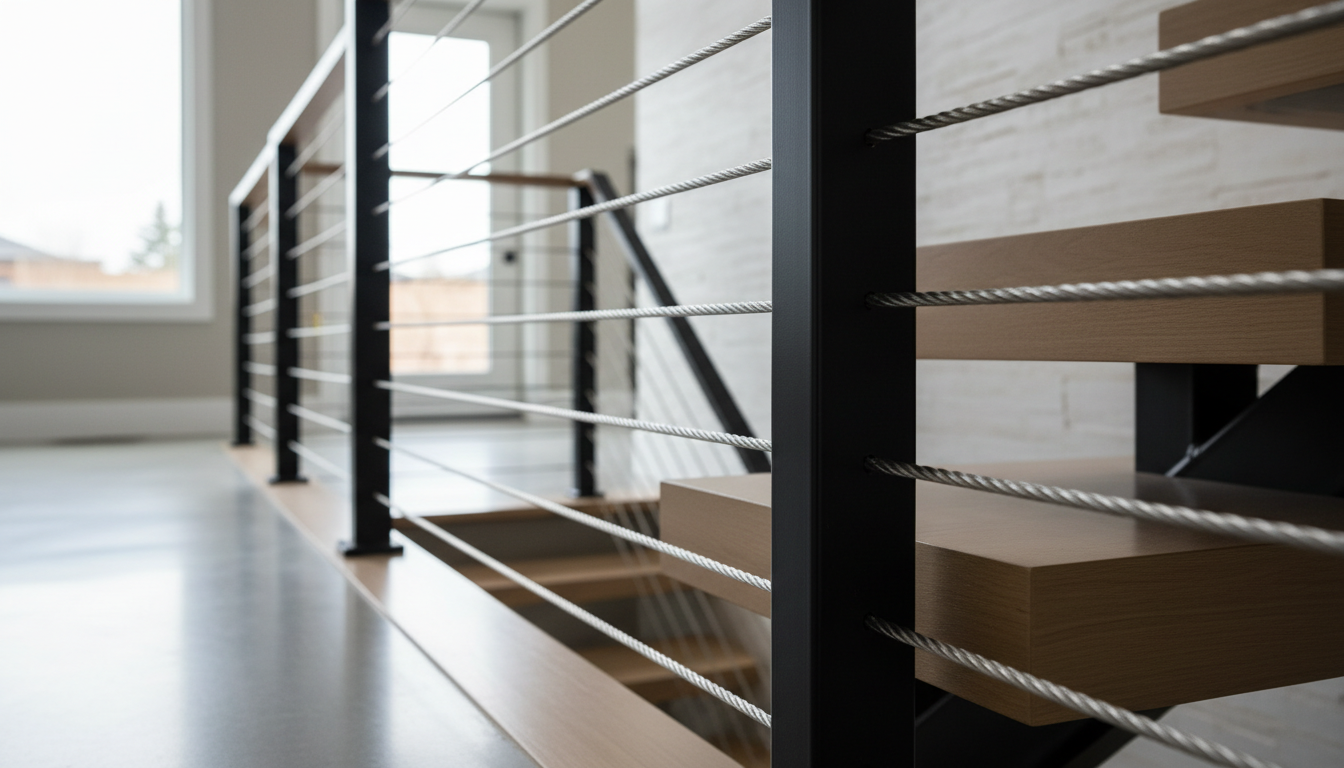
- Floating staircase focal points: On a mono-stringer or cantilevered floating staircase where the tread is the primary visual element, walnut’s rich, absorptive colour elevates the architectural statement. The absence of closed risers means the tread face is viewed from multiple angles — exactly where walnut’s grain depth performs best. See our floating staircase Ontario guide for full structural and material specifications.
- High-end new builds in Barrie or Simcoe County: Where the staircase is positioned as a feature element and the budget reflects the overall finish quality of the build. Walnut on a feature staircase in a $1.5M+ Barrie home reads differently than walnut in a $700K standard build where it may feel out of proportion with surrounding finishes.
- Owner-occupied long-term homes: Because walnut’s lighter durability rating is more than adequate for an owner-occupied home with normal traffic patterns, and the material rewards years of maintenance (it repolishes beautifully with minimal sanding).
When walnut is NOT the right choice:
- High-traffic rental properties or multi-unit buildings where impact and scratch resistance must be maximized
- Homes with large dogs (claws concentrate point loads on soft-grade wood at nosings)
- Projects where budget pressure exists — the white oak alternative delivers 95% of the visual impact at 60–80% of the tread material cost
- Light-coloured interior designs where the contrast between walnut and surrounding finishes would be jarring rather than intentional
Considering a floating vs traditional staircase system with walnut treads? Our floating staircase vs traditional Ontario comparison covers how the structural choice affects tread specification and total budget.
Frequently Asked Questions: Walnut Stair Treads Ontario
Q1: Are walnut stair treads durable enough for an Ontario family home?
Yes — with the right finish specification and tread thickness (minimum 1.5 inches). Walnut at 1,010 Janka is softer than white oak but adequate for a residential home with 2–4 occupants. The wear difference versus white oak becomes visible over 10+ years at high-traffic nosings, not in the first few years of use.
Q2: How much more do walnut stair treads cost compared to white oak in Ontario?
$60–$120 more per tread in Select & Better grade. For a typical 14-tread flight, this is $840–$1,680 in additional material cost over white oak. The total project cost difference is smaller as a percentage when the full staircase (stringers, railings, installation) is included.
Q3: Do walnut stair treads change colour over time?
Yes — black walnut lightens significantly with UV exposure. Freshly installed walnut is dark chocolate-brown. After 2–3 years of normal ambient light exposure, heartwood shifts to a warmer caramel tone. This is a natural characteristic of the species, not a finishing defect. Using a UV-inhibiting topcoat slows but does not stop this process.
Q4: Can walnut stair treads be refinished?
Yes. With a minimum 1.5-inch thickness, walnut treads can be sanded and refinished 2–3 times over their lifetime (removing approximately 1/8 to 3/16 inch per refinish). The refinishing process is identical to white oak. C.O.R.S recommends refinishing when surface scratching becomes visually significant rather than on a fixed schedule.
Q5: What is the best finish for walnut stair treads in Ontario?
Clear oil-modified polyurethane in 3 coats for film finish durability, or Rubio Monocoat hardwax oil for a natural-looking penetrating finish. Avoid dark stains on walnut — the natural heartwood colour is already the aesthetic, and staining over it typically obscures the grain depth without adding colour value.
Q6: Does C.O.R.S stock walnut stair treads in Barrie?
Walnut is a special-order species for C.O.R.S, with a 2–4 week lead time from our Ontario lumber suppliers. It is not stocked in-warehouse because tread dimensions are cut to your specific stair geometry. Every tread is cut to your exact run dimension, thickness, and nosing profile.
Q7: Can I use walnut treads on a floating staircase?
Yes — walnut treads are an excellent choice on floating staircases where the tread face is the primary visual element. The rich grain and colour depth perform particularly well on open-riser systems where each tread is viewed from multiple angles. For floating staircase structural information, see our complete floating staircase Ontario guide.
Q8: Is walnut a sustainable choice for Ontario stair treads?
Black walnut (Juglans nigra) is commercially available from sustainably managed forests in Ontario and the northeastern United States. It is not a threatened species. Buying domestic black walnut from Ontario or nearby US sources reduces transportation footprint compared to importing exotic hardwoods with similar colour profiles.
Get a Walnut Stair Tread Quote from C.O.R.S in Barrie
If you are considering walnut stair treads for your home in Barrie, Innisfil, Essa Township, Collingwood, or anywhere in Simcoe County, C.O.R.S can provide material samples, tread thickness recommendations, and a full installed quote. Every quote includes the material cost, nosing profile, finish specification, and installation as a single all-in number — no hidden lumber or machining fees.
No Simcoe County travel surcharge. Free on-site assessment for all staircase projects.
Call or text C.O.R.S: 705-999-0000
Quote form: corsstairs.ca/contact

2 Responses